Experts
Shuck Off Ehrlich's Oysters
Environmentalists Question Timeline
By
Anita Huslin
Washington Post Staff Writer
Friday, June 20, 2003; Page B06
Gov. Robert L. Ehrlich Jr.
leaned closer yesterday as the Maryland scientist cradled an Asian oyster in one
hand and carefully slipped a knife into the hinge that held its two shells
together.
Gently prying them apart, the
scientist revealed with a flourish the glistening mass of flesh inside -- more
than twice as big and plump as the native Chesapeake oyster that sat shucked on
the table beside them.
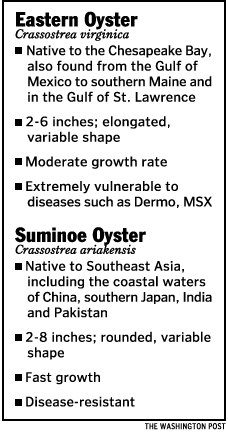
"It's younger, it's bigger,
and it filters more," said Chris Judy, chief of the shellfish division for
the Maryland Department of Natural Resources, highlighting the attributes that
have made the exotic oyster so tantalizing to scientists, watermen -- and now
for the first time, Maryland's top politician.
"The new oyster is a
survivor, not decimated by disease," Ehrlich said, clearly salivating at
the prospect of a flashy new oyster that could burnish his credentials as a
friend of the environment and savior of what was once the region's most
lucrative industry.
Which is why, Ehrlich said,
Maryland will join forces with Virginia to accelerate a process that could allow
the states for the first time to introduce batches of the fertile bivalves to
open waters of the Chesapeake Bay as soon as next summer.
"This is a dynamic,
dramatic and important development," Ehrlich said at a news conference on
the dock of a downtown seafood restaurant in Annapolis. "I'm anticipating a
lot of buying in . . . from every group that has a stake in the future of our
bay."
Scientists and politicians agree
that for the bay to be saved, it will need more of the filtering mollusks. Once
so abundant that they could suck in all the water of the bay and spit it out
clean in three days, it now takes the remaining population of indigenous oysters
-- weakened and devastated by disease -- more than three years to do the job.
The decline has also devastated
the bay's oyster industry, once the world's top source of the succulent
bivalves.
Watermen cheered yesterday
Ehrlich's goal of introducing the new oyster and his hopes of repopulating the
bay with billions of them.
But environmentalists and
scientists said they were unnerved by the administration's call to accelerate a
federal study of the benefits and risks of such a plan, compressing into one
year a process that normally takes three to five.
Ehrlich's announcement preempts
a report expected from the National Academy of Sciences this summer that will
sum up the research that has been done on the Asian oyster to date and note what
scientists still don't know about the animal's habits and what might happen if
introduced to the bay.
While the governor pledged to
"de-politicize science as it has been practiced by this state in the
past," some scientists suggested that his announcement sent a signal that
he does not want studies to unduly delay a decision on the Asian oysters.
"That seems to be the major
message," said Stan Allan, who is with the Virginia Institute of Marine
Sciences and is breeding sterile Asian oysters for test projects in Virginia,
North Carolina and, he hopes, Maryland. "Let's get on with this and not
dilly-dally."
Environmentalists caution that
it is too early to talk about releasing a breeding population into the bay when
so much about the creature's potential habits in the Chesapeake is unknown.
What, for example, would it eat? Could it become a host for a disease that's now
dormant in the bay but could flare up and affect other species such as rockfish
or crabs? Could it interrupt the reproductive cycle of native oysters? Would it
duplicate the reef-building habits of the native oysters, which provide critical
habitat for young crabs, fish and other bay species?
After spending last summer
fighting another Asian species, the Northern snakehead fish, some scientists are
reluctant to release the new oysters into the bay without more answers.
Chesapeake Bay Foundation
scientist Bill Goldsborough expressed doubt that enough research could be done
in the accelerated timetable Ehrlich described to allow for safe introduction of
a breeding stock.
"There's a whole spectrum
of possible viewpoints on an issue like this," Goldsborough said. "At
one end is a maximum sensitivity to the risks of non-native introductions. At
other end is complete dismissal of that concern and motivation based on
commercial, political or other interests."
"I certainly see the
previous administration as being more toward the conservative end of that
spectrum than the current one," he said. "That's not a judgment call.
It's just the way it is."
© 2003 The Washington Post Company