| "Extinct" Woodpecker Flies Back from the Beyond |
 |
| From: Scientific American, April 29,2005 |
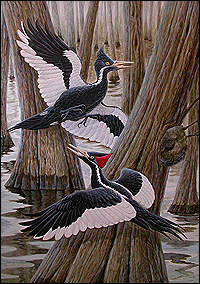
The ivory-billed woodpecker (Campephilus principalis) is one of the world's largest woodpecker species, with a wingspan of nearly three feet. Though never commonplace, the bird inhabited lowland primary forest across the southeastern U.S. until logging between 1880 and the 1940s largely destroyed its habitat. Anecdotal reports of the bird have surfaced on occasion since the last conclusive observation, but researchers suspected that what viewers had actually seen was the superficially similar pileated woodpecker, which is relatively abundant in the southern U.S. In 2004, however, biologists saw the bird on multiple occasions, and, crucially, captured it on video. Although blurry and pixelated, the video images reveal five diagnostic features of the ivory-billed woodpecker, including its size (as determined based on the known trunk diameter of the tree on which the bird was perched), the distinctive black-and-white markings on its wings and the white plumage o n its back. Subsequent field surveys of more than 16 square miles of Big Woods forest around the area in which observers initially saw the bird failed to turn up any occupied roost holes. Indeed, the team cannot exclude the possibility that all of their sightings were of the same bird, a male sporting the signature crimson crest. But the investigators note that they have searched only a fraction of the creature's potential habitat. Ivory-bills were known to travel far and wide to find recently dead trees suitable for roosting, and any now living could cover hundreds of square miles. If some breeding pairs still exist, the scientists remark, conditions favoring population growth are becoming increasingly available to them, thanks to forest restoration efforts by both public and private landowners. "Just to think this bird made it into the 21st century gives me chills," comments team member Tim W. Gallagher of Cornell University. "It's like a funeral shroud has been pulled back, giving us a glimpse of a living bird, rising Lazarus-like from the grave." A paper detailing the rediscovery was published online today by the journal Science. --Kate Wong |